




Name
Western Governors University
D024 Professional Presence and Influence
Prof. Name
Date
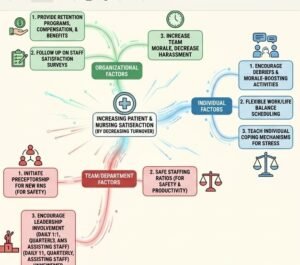
Increasing patient and nursing satisfaction while reducing turnover requires a multi-tiered approach that addresses organizational, departmental, and individual factors. Healthcare organizations can significantly boost nurse retention, lower burnout, and elevate patient outcomes by optimizing workplace culture, implementing safe staffing ratios, supporting leadership engagement, and promoting healthy work-life integration.
Building a sustainable work environment begins at the institutional level. Healthcare organizations must actively invest in retention programs that focus on competitive compensation, comprehensive benefits packages, and long-term career growth opportunities. Financial incentives paired with career advancement pathways demonstrate a clear commitment to valuing nursing staff.
In addition to compensation, executive leadership must establish structured feedback loops. Regularly conducting staff satisfaction surveys—and visibly acting on the feedback gathered—builds trust between frontline nurses and administration. Furthermore, organizations must proactively foster a culture that prioritizes team morale and maintains a zero-tolerance policy for workplace harassment and incivility.
Departmental culture and daily operating conditions directly impact a nurse’s day-to-day experience. Implementing safe, evidence-based nurse-to-patient staffing ratios is one of the most effective ways to increase patient safety, boost staff productivity, and lower stress levels.
To further strengthen departmental support and retention, units should focus on key leadership and onboarding initiatives:
Preceptorship Programs: Establish formal precepting programs for new Registered Nurses (RNs) to help them transition smoothly and feel psychological and professional safety in a new clinical environment.
Active Leadership Presence: Encourage unit leaders to be an active part of the floor routine through daily check-ins, quarterly one-on-one reviews, and stepping in to assist directly when staff feel overwhelmed.
While structural support is critical, individual factors play a vital role in long-term resilience and job satisfaction. Encouraging team-building activities, informal debriefs after high-stress incidents, and social connections helps staff build strong professional relationships and a reliable peer support network.
At the individual level, supporting flexible scheduling options allows nurses to achieve a healthy work-life balance, directly impacting overall job satisfaction. Additionally, encouraging nurses to develop personal coping mechanisms and stress-management techniques empowers healthcare professionals to navigate high-pressure work environments effectively.
American Nurses Association. (2020). Nurse staffing and patient care. https://www.nursingworld.org/practice-policy/nurse-staffing/
Buchan, J., Catton, H., & Shaffer, F. A. (2021). Sustain and retain in 2022 and beyond: The global nursing workforce and the COVID-19 pandemic. International Council of Nurses. https://www.icn.ch/publications/sustain-and-retain-2022-and-beyond
Drennan, V. M., & Ross, F. (2019). Global nurse shortages and the migration of nurses. British Medical Bulletin, 130(1), 55–67. https://doi.org/10.1093/bmb/ldz014